
Have We Made Podcasting Too Convenient?
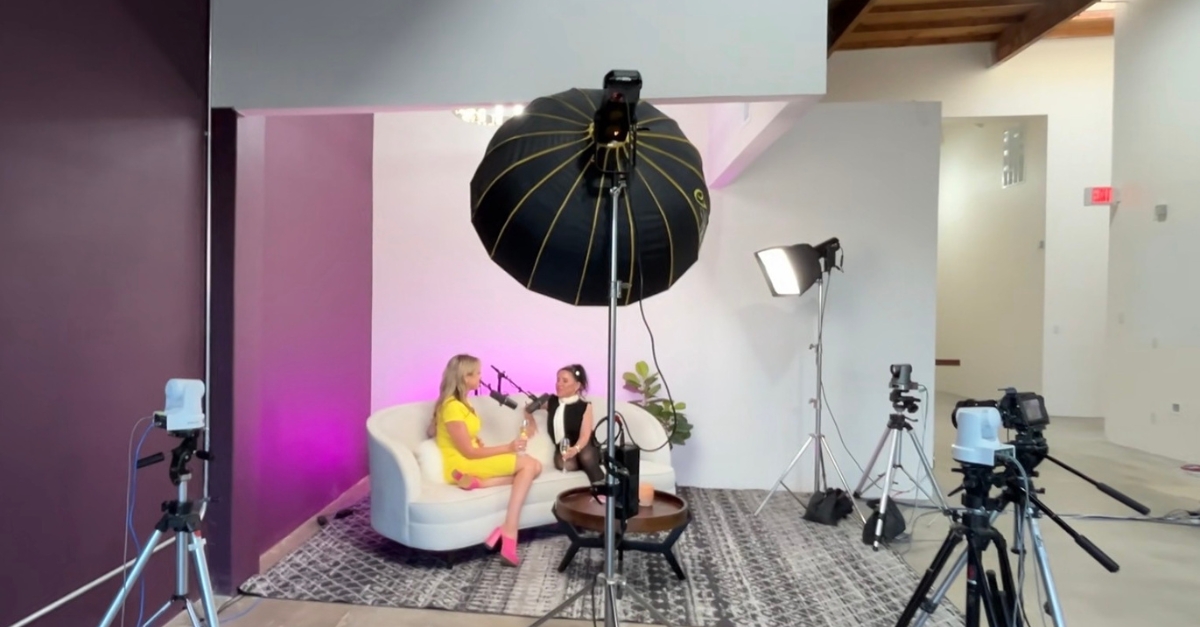
A little while ago, I watched two women record an interview in our studio over glasses of champagne.
They laughed before we started. They clinked glasses. As the conversation unfolded, their body language began to mirror each other in the quiet ways people do when they are genuinely engaged. One shifted in her chair, and not long after, the other did too. They leaned toward each other. They reacted before the other person had quite finished speaking. The conversation wandered into places that I am not convinced anyone had planned.
Maybe the champagne deserves some credit.
But watching them made me think about something podcasting has become very good at solving: inconvenience.
Remote recording has made it possible to interview almost anyone, almost anywhere, without airfare, studio time, complicated calendars, or asking a guest to fight traffic across Los Angeles. That has been enormously good for podcasting.
I am just not sure it has been good for every conversation.
Convenience solved a real problem
This is not an argument against remote recording.
Remote platforms have opened doors that simply would not exist otherwise. A host in California can speak with an expert in London in the morning and another in New York that afternoon. Independent creators can produce shows without the cost of a studio. Guests with packed schedules can participate from their offices or homes.
There are plenty of interviews that would never happen if everyone had to be in the same room.
But somewhere along the way, convenience became the default rather than one of the available tools. And when the goal is a conversation worth watching or listening to, I think it is worth asking what we traded for that convenience.

There is another conversation happening underneath the interview
Human beings communicate with far more than words.
We read posture, gaze, tiny facial movements, timing, physical distance, and changes in energy. We notice when someone leans forward. We feel when a pause means, “keep going,” rather than, “I think the Wi-Fi froze.”
Research increasingly suggests that physical presence changes some of those exchanges.
A Yale study published in Imaging Neuroscience compared live face-to-face interaction with a live, webcam-mediated version of the same interaction. Researchers found longer visual engagement, greater physiological arousal, stronger activity in brain regions associated with social processing, and greater coordination between the brains of the people interacting in person. The researchers described dynamic facial reciprocity as important for “creating meaningful social bonds.”
That does not mean two people on Zoom cannot connect deeply. Of course they can. It means the medium is not necessarily neutral.
Another body of research looks at interpersonal synchrony, the subtle tendency for people interacting with one another to coordinate movements and behaviors over time. A meta-analysis of 60 experiments described synchrony as “the basis for social connection and understanding” and found that it had meaningful effects on prosocial attitudes and behavior.
You do not need to know that someone’s brain activity is synchronizing with yours to recognize the feeling.
We have all had conversations where the room seems to disappear.
The screen changes more than where we are sitting
There is another interesting clue from research on creativity.
In a study published in Nature, researchers compared pairs working together face-to-face with pairs collaborating through video. Across both laboratory testing and a field experiment involving employees in five countries, the virtual pairs generated fewer creative ideas. The researchers traced part of the difference to attention: people on video tended to focus more narrowly on the screen and less on the environment around them. They described virtual interaction as carrying a “cognitive cost for creative idea generation.”
Again, this was not a podcast study. Brainstorming is not interviewing.
But interviews also depend on discovery.
The best follow-up question is often the one the host did not write down. A strange answer opens another door. Something in the guest’s expression says there is more there. A shared laugh changes the tone. The conversation takes a left turn and suddenly gets much more interesting.
That is difficult to quantify, but it is often the difference between an interview that delivers information and one people remember.
The interview starts before the cameras do
There is another part of in-person recording that is easy to overlook because it never appears in the finished episode.
The guest arrives.
Someone greets them. They see the room. They get coffee, water, or apparently champagne. They talk before anyone says, “We’re rolling.”
By the time the actual interview begins, host and guest have already spent time together as people.
That matters.
For a branded show or a thought-leadership series, coming into a studio also sends a subtle message: this conversation was worth making time for.
Traveling somewhere, sitting down together, and creating an environment specifically for the conversation introduces intention. It feels different from squeezing another video call between two calendar notifications.
That does not automatically produce a better interview. A beautiful studio cannot rescue an unprepared host, and expensive cameras have yet to develop the ability to ask a useful follow-up question.
But the environment can create better conditions for the conversation.

There is also freedom in not being the technician
Anyone who has recorded remotely knows the pre-interview ritual.
Which microphone is selected? Are the headphones connected? Why is the browser asking for permission again? Is that the right camera? Can you move closer to the router? No, closer than that.
Meanwhile, the host is thinking about recording quality, the guest is wondering whether they look strange in the little self-view window, and everyone is trying to remember what they were actually going to talk about.
In a properly run studio session, those jobs belong to somebody else.
The host can host.
The guest can be a guest.
The production team worries about microphones, cameras, lighting, recording, levels, backups, and whatever technical problem has decided today is its day to become interesting.
That reduction in cognitive load has value beyond technical quality. It gives the people having the conversation more room to pay attention to each other.
And yes, it looks and sounds dramatically better
The bigger investment may be in the conversation itself.
There is no reason to pretend production quality is irrelevant.
Professional microphones in controlled rooms sound better. Intentional lighting looks better. Multiple cameras create editorial choices. A production team can catch problems while they are still fixable. Proper audio and picture post-production can turn a good recording into a finished piece of media that represents the people and brand behind it well.
For companies investing in thought leadership or branded programming, that matters.
But I would argue that production quality is not the most interesting reason to bring people together.
The bigger investment may be in the conversation itself.

Does every podcast need to be recorded in a studio?
Absolutely not.
If recording in person means you produce six episodes a year instead of fifty, the math may not work. If the perfect guest is three states away, call them. If you are an independent creator building a show on a limited budget, a quiet room, a couple of good microphones, and two people sitting across from one another can capture much of what matters without a professional facility.
Remote recording is not the enemy.
The mistake is assuming the easiest production method is automatically the best one for every kind of conversation.
For quick interviews, geographically distributed guests, news-driven shows, or high-volume production, remote may be exactly the right choice.
But when an episode matters – when the guest matters, when vulnerability matters, when the brand is investing in the conversation, or when you want the interview to go somewhere neither person could completely predict – there is still something powerful about sharing the same room.
Podcasting became easier when we stopped requiring that.
Maybe sometimes we should require it anyway.